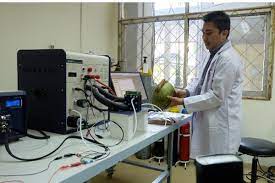
Magnetic Torque Measurement System - SteornLab


Magnetic Torque Measurement System

This system is specifically designed to measure the 'pure torque' of permanent magnetic interactions during rotary motion. 'Pure Torque' refers to the torque that the system experiences due to magnetic interactions only. The effects of friction, gravity, ringing and air resistance are removed from the resulting datasets.

The major component of the magnetic torque measurement systems is the measurement arm. A Magnetic Torque Measurement System arm provides angular position and torque measurement of its axis. The arm is designed to measure the torque acting between a magnetic material rotating about its axis and a fixed magnetic material. A measurement arm consists of four key components:

  • Angle Encoders
  • Torque Sensor
  • Drive System
  • Displacement Sensors
  • Data Acquisition and Control Software


Key Features

Key Features of the Magnetic Torque Measurement System are:

  • Measurement of pure torque during magnetic interactions
  • Flexible position of measurement arms.
  • Accuracy
  • Fully automated
  • Deflection measurement during interactions
  • Quasi static or fixed rotational speed measurement

The system is designed to be flexible, so that multiple arms may be positioned at a variety of different angles with respect to each other, or indeed to measure around the same rotary axis.

Key Components

Angle Encoder

The encoder provides a precise angle position about the measurement arm's shaft axis. The angle encoder is quadratic, with a fixed home position and 8192 measurements per 360 degree rotation.

Two non-contact angle encoders can be connected to either end of the measurement arm. The purpose is to provide precise angle position about either end of the measurement arm's shaft axis. Consequently, any difference between the two encoder angles at either end of the measurement arm's shaft axis will highlight the effects of torsional forces within the shaft.

Torque Sensor

A 100 mNm torque sensor is connected to the measurement arm although other range torque sensors can also be used.

The torque sensor measures the torque acting on the arm's shaft axis. The torque sensor is decoupled from the effects of axial and radial forces via a Zero-Max and a Ruland coupling, chosen for their torsional stiffness, low backlash and resistance to inducing unwanted loading on torque sensor.

Drive System

A drive system is connected to the measurement arm. The drive system consists of a micro-stepper motor and a 50:1 anti-backlash gearbox. The drive system allows for precise positioning, or stepping, of the measurement arm in static or dynamic motion.

Displacement Sensors

Two CCD laser displacement sensors are positioned such that they can monitor any lateral movement in the position of the magnetic materials. One displacement sensor is used to detect any movement in the Z-plane of the measurement arm's rotational shaft axis. The other displacement sensor is used to detect any movement in the Z-plane of the fixed magnetic material. The displacement sensors project a laser spot of 0.03mm diameter at both the arm's shaft and the static magnetic material. The laser spot is reflected into a CCD sensor such that the target distance can be measured to a resolution of 0.005 mm. Consequently, any attraction or repulsive forces that result in physical deflection of either of the magnetic materials may be detected.

Data Acquisition and Control Software

Rotational control of the measurement arm's shaft, and acquisition of the measurement signals from the angle encoder, torque sensor, drive system and displacement sensors, is performed by an MS-Windows™ based PC containing a National Instruments (NI) Data Acquisition Card (DAQ).

A 'C' program written using the NI CVI™ Application Framework coordinates the motion of the stepper motor and the timing of the acquired angle, torque and laser sensor signals.

In essence the application works by rotating the arm's shaft and recording the torque, angle and deflection sensor values for every shaft angle change detected. The resulting measurement data is stored in CSV and MS-Excel™ files.

Purchasing Details

For pricing and purchasing details please contact contact us.